


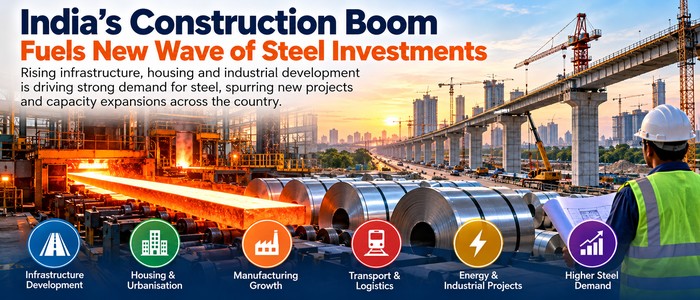
Rising demand from infrastructure, housing, industrial development and manufacturing is encouraging steel producers to invest in new plants, modernisation and capacity expansions, positioning India for another major phase of industrial growth.
New Delhi, October 20, 2026: India's iron and steel industry is witnessing a fresh wave of investment activity as the country's expanding construction and infrastructure landscape creates growing demand for steel products. From highways, metro rail networks and airports to residential developments, industrial corridors and manufacturing facilities, the ongoing construction boom is emerging as a major catalyst for investment in steelmaking capacity across the country.
A steady stream of new steel plant proposals, rolling mill expansions, sponge iron facilities, induction furnace installations and integrated steel projects suggests that investment momentum is spreading beyond India's largest steel manufacturers to regional producers and secondary steel companies.
The trend reflects a wider transformation in India's industrial economy, where large-scale infrastructure development is stimulating investment not only in construction projects but also in the industries supplying essential building materials.
India's sustained investment in roads, bridges, railways, metro systems, airports, ports, housing and industrial infrastructure is providing a strong foundation for steel demand. Expanding urbanisation, commercial real estate development, logistics parks and manufacturing facilities are further strengthening consumption of structural steel, reinforcement bars, plates and other steel products.
The scale of this demand is becoming increasingly visible in industry statistics. India's finished steel consumption reached approximately 164 million tonnes in FY2025–26, compared with around 77 million tonnes in FY2014–15, demonstrating how substantially the domestic steel market has expanded over the past decade.
This growth is encouraging steel producers to prepare for higher future consumption by investing in additional production capacity, downstream processing facilities and supporting infrastructure.
Large steel manufacturers are already committing substantial capital to capacity expansion.
JSW Steel, one of India's leading private-sector steel producers, has outlined an approved capital expenditure programme of approximately ₹1.26 lakh crore over the coming four to five years. Its expansion roadmap includes new steelmaking facilities, brownfield capacity additions, downstream manufacturing and raw material infrastructure.
Among the significant investments are a proposed ₹31,600 crore, 5 million tonnes per annum greenfield steel plant at Paradip in Odisha, alongside a ₹26,000 crore, 5 MTPA expansion at Vijayanagar in Karnataka.
The company aims to raise its domestic steelmaking capacity, including joint ventures, to approximately 78 MTPA by FY2031–32.
Other major producers, including Tata Steel, Steel Authority of India Limited and Jindal Steel, are also pursuing various expansion and modernisation programmes, reflecting expectations of continued growth in domestic steel consumption.
An important feature of the current investment cycle is the growing number of projects emerging from smaller and medium-sized steel manufacturers.
Recent project reports from Chhattisgarh, West Bengal, Gujarat and other industrial states indicate proposals for new steel melting shops, rolling mills, induction furnaces, sponge iron facilities, ferroalloy units and captive power generation.
These investments are particularly relevant because secondary steel manufacturers play a major role in supplying construction-grade steel and intermediate products to regional markets.
Unlike large integrated steel plants, many secondary-sector projects involve comparatively smaller capital commitments and can be implemented in phases, allowing manufacturers to expand production in response to regional demand.
The geographical spread of such proposals suggests that the industry's expansion is not limited to established steelmaking centres but is increasingly connected to industrial development across multiple states.
The Government of India's long-term steel-sector ambitions are another important factor behind the investment momentum.
The National Steel Policy established a target of 300 million tonnes of crude steelmaking capacity by 2030–31, encouraging the industry to prepare for sustained growth in infrastructure and manufacturing demand.
Beyond conventional construction steel, rising investment in automotive manufacturing, renewable energy, electrical equipment, railways and engineering industries is creating additional opportunities for higher-grade and specialised steel products.
The combination of domestic demand, government infrastructure spending, industrial diversification and technological modernisation is therefore encouraging manufacturers to take a longer-term view of capacity development.
The emerging investment cycle could create substantial opportunities for engineering, procurement and construction companies, industrial equipment manufacturers and technology providers.
New steel plants and capacity expansions require substantial investment in civil construction, structural fabrication, furnaces, continuous casting machines, rolling mills, material-handling systems, power distribution, water treatment, pollution-control equipment and industrial automation.
Supporting infrastructure, including roads, railway sidings, storage yards, captive power facilities and logistics systems, could generate additional project opportunities.
As proposed projects progress through approvals, financing and implementation, the steel sector could become an important source of industrial EPC contracts and capital equipment orders over the coming years.
While the investment outlook remains encouraging, the pace of actual project implementation will depend on market conditions and financial viability.
Steel manufacturers continue to face challenges from fluctuating raw material prices, dependence on imported coking coal, energy costs, environmental compliance requirements and competition from international steel suppliers.
There is also a distinction between projects proposed for environmental clearance and investments that have received final approval, secured financing or entered construction. Not every announced expansion will necessarily translate into immediate capital expenditure.
Rapid capacity expansion without corresponding demand growth could also create pricing pressure and affect industry profitability.
Consequently, investment announcements will need to be assessed alongside actual construction progress, equipment procurement, contract awards and commissioning schedules.
India's ongoing infrastructure and construction expansion is increasingly creating demand across the broader industrial supply chain, and steel manufacturing is emerging as one of the major beneficiaries.
The growing number of proposed steel projects, combined with large capital commitments from established producers, indicates that the industry is positioning itself for a sustained period of capacity addition and technological upgrading.
The larger story is no longer limited to the construction boom itself. It is the industrial investment cycle being generated by that boom.
As India continues to build highways, cities, factories, transport systems and energy infrastructure, the requirement for steel is likely to remain an important driver of manufacturing investment.
If domestic consumption maintains its growth trajectory and planned projects move successfully into implementation, the current expansion could develop into one of the country's significant industrial capital expenditure cycles over the coming decade.

This site is best viewed with a resolution of 1024x768 (or higher) and supports Microsoft Internet Explorer 4.0 (or higher)
Copyright © 2016-2026
 Premium Projects Database
 Project Marketing Assistance
 EPXonline.com


