


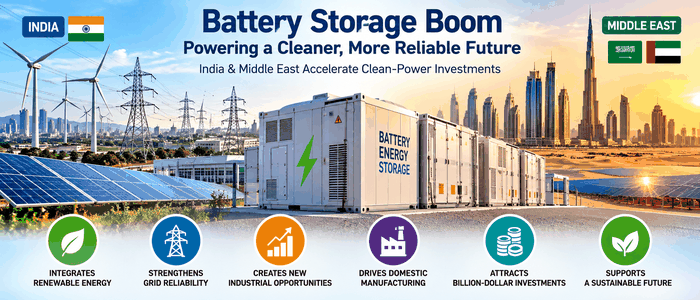
New Delhi/Dubai, September 30, 2026: Battery energy storage is rapidly moving from a supporting technology to a mainstream segment of power infrastructure, creating a new multi-billion-dollar market for battery manufacturers, EPC contractors, electrical-equipment companies, software providers and renewable-energy developers across India and the Middle East.
India's latest policy push could significantly accelerate this transition. The Union Cabinet has approved a ₹1.86 lakh crore renewable-energy infrastructure programme, including approximately ₹50,000 crore of incentives for 50 GWh of battery energy storage systems (BESS). Another ₹1.36 lakh crore will support transmission infrastructure required to evacuate up to 135 GW of renewable power.
The scale-up could be rapid. CRISIL Ratings expects India to commission around 45–50 GWh of BESS during FY2027 and FY2028, compared with only about 1 GWh at the end of FY2026. Around 40 GWh has already been awarded through government-backed auctions, while commercial and industrial customers are expected to create another sizeable market.
The key driver is the changing shape of electricity supply.
Solar generation peaks during the daytime, while electricity demand often remains strong after sunset. Batteries allow utilities to purchase or generate electricity when renewable output is abundant, store it and release it during evening peak periods.
This is transforming renewable projects from intermittent power producers into increasingly dispatchable energy assets.
The next phase of the market is therefore likely to move beyond standalone solar and wind projects toward combinations such as solar-plus-storage, wind-solar-storage hybrids and round-the-clock renewable-energy projects.
India's commercial and industrial sector is also emerging as an important customer base. Cement, steel, chemicals, data centres and other electricity-intensive industries can combine captive renewable generation with batteries to reduce peak power costs and increase the proportion of renewable electricity in their operations.
The beneficiaries of the storage boom extend far beyond battery-cell manufacturers.
A large BESS project requires battery cells and modules, containers, power conversion systems, transformers, switchgear, substations, cables, cooling equipment, fire-detection and suppression systems, control systems and sophisticated energy-management software.
This creates opportunities for several industries:
Battery manufacturers could benefit from sharply rising demand for lithium iron phosphate and other advanced chemistry cells.
Electrical-equipment manufacturers supplying transformers, switchgear, cables, inverters and substations are likely to see incremental demand as utility-scale storage projects connect to transmission and distribution grids.
Engineering and construction companies will increasingly compete for integrated EPC contracts covering civil works, electrical systems, grid interconnection and commissioning.
Cooling and fire-safety companies represent another important emerging segment because thermal management and battery-fire protection are critical requirements for large storage installations.
Software and digital companies can participate through battery-management systems, energy-management platforms, artificial intelligence-based forecasting, predictive maintenance and electricity-market optimisation.
India is simultaneously attempting to create a domestic battery-manufacturing ecosystem.
The government's Advanced Chemistry Cell production-linked incentive scheme targets 50 GWh of manufacturing capacity, with 40 GWh already allocated to selected companies. Beneficiaries include Reliance New Energy Battery Storage, Ola Cell Technologies and ACC Energy Storage, among others.
The expansion of domestic BESS deployment could therefore provide manufacturers with a sizeable home market in addition to demand from electric vehicles.
The longer-term opportunity also extends upstream to battery materials, cathodes, anodes, electrolytes, separators and battery recycling, potentially creating a broader energy-storage manufacturing cluster.
The Gulf is pursuing even larger individual projects.
Saudi Arabia recently awarded four utility-scale storage projects totalling 2,000 MW/8,000 MWh, representing investment of more than $1.16 billion. The four projects, each sized at 500 MW/2,000 MWh, are being developed under 15-year storage agreements through consortiums led by ACWA Power and Engie.
The model is noteworthy because storage is increasingly being treated as an independent infrastructure business, similar to conventional power generation, rather than simply as equipment attached to a solar project.
The UAE is going further.
Masdar and Emirates Water and Electricity Company are developing a $6.1 billion round-the-clock renewable-energy project in Abu Dhabi, combining 5.2 GW of solar capacity with 19 GWh of battery storage. The project is designed to deliver approximately 1 GW of continuous renewable electricity.
CATL has been selected as the preferred battery-storage supplier, while Larsen & Toubro and POWERCHINA are preferred EPC contractors. JA Solar and Jinko Solar are supplying photovoltaic modules.
The involvement of India's Larsen & Toubro illustrates an important opportunity for Indian engineering and equipment companies to participate in the Gulf's rapidly expanding energy-storage market.
Several new business models are likely to emerge as storage deployment expands.
Developers can increasingly earn revenues not only from selling electricity but also from capacity availability, peak-power supply, ancillary grid services, frequency regulation and energy arbitrage.
Specialised companies may also emerge to provide Battery Energy Storage as a Service, allowing industrial customers to use storage without making the full upfront capital investment.
Another potentially large opportunity is the replacement and augmentation market. Battery systems gradually lose capacity over their operating life, creating recurring demand for replacement modules, maintenance, software optimisation and eventually recycling.
Data centres could become particularly important customers. The rapid growth of AI and cloud infrastructure is creating demand for reliable 24-hour electricity supplies, while operators are simultaneously seeking lower-carbon power. Solar and wind projects combined with large batteries could increasingly serve these facilities.
The rapid expansion is not without risks.
CRISIL has warned that 8–9 GWh of India's awarded storage projects could face delays, reflecting rising battery costs, aggressive bidding and relatively limited execution experience among some developers. Battery prices have also risen from unusually low levels seen in 2025, putting pressure on project returns.
Dependence on imported cells and components remains another strategic concern, strengthening the case for domestic manufacturing and diversified supply chains.
The broader trend is clear: battery storage is evolving from a niche renewable-energy accessory into a major infrastructure industry.
India's combination of 50 GWh of new incentives, rapidly expanding project awards and domestic battery manufacturing, together with Saudi Arabia's multi-gigawatt procurements and the UAE's 19-GWh flagship project, suggests that the sector is entering a period of accelerated investment.
For businesses, some of the largest opportunities may ultimately lie outside battery manufacturing itself — in EPC services, power electronics, transformers, cooling, fire safety, grid integration, digital energy management, financing, operations and recycling.
The companies capable of providing complete, reliable and bankable storage solutions could therefore become important participants in the next phase of the global power-infrastructure market.

This site is best viewed with a resolution of 1024x768 (or higher) and supports Microsoft Internet Explorer 4.0 (or higher)
Copyright © 2016-2026
 Premium Projects Database
 Project Marketing Assistance
 EPXonline.com

