India’s Semiconductor Investment Boom: New Projects, Global Investors and the Next Manufacturing Opportunity
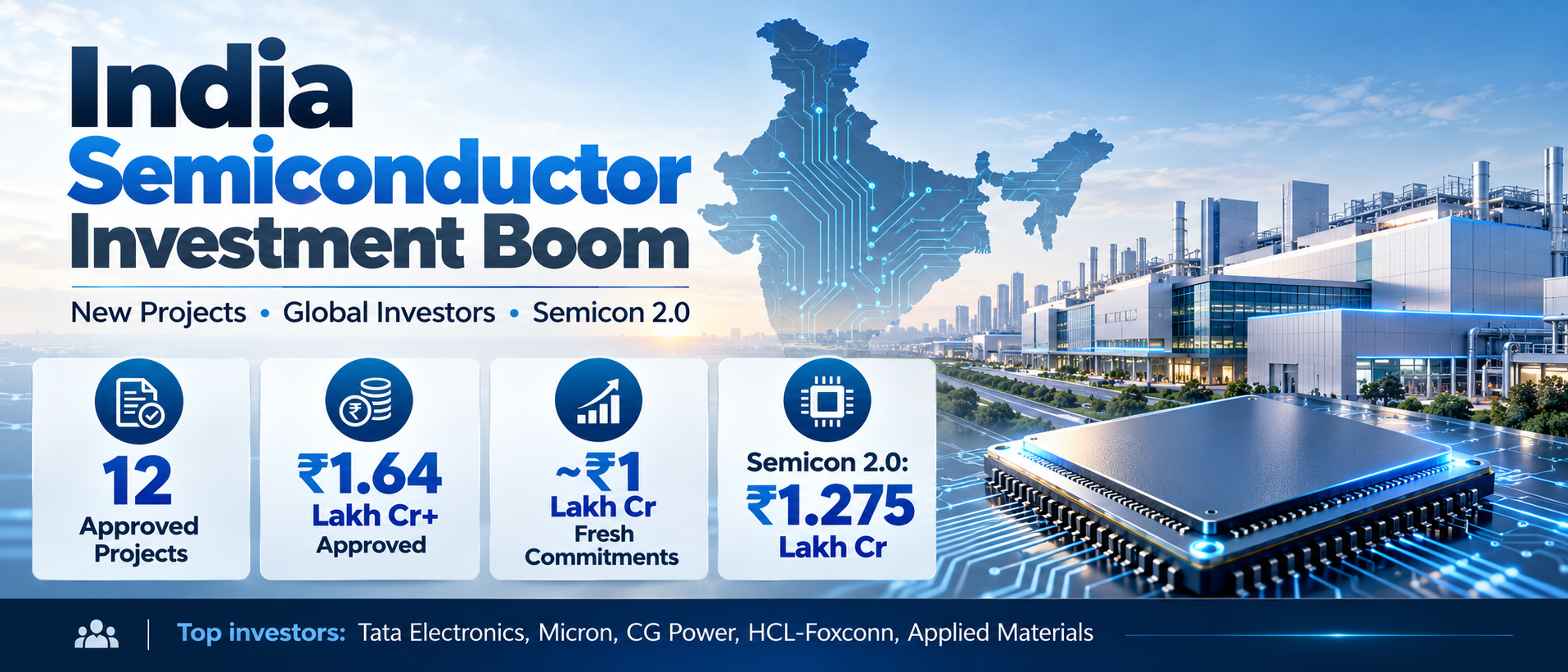
India’s semiconductor sector is entering a new investment phase, with chip fabrication, assembly and testing, compound semiconductors, equipment, materials and R&D attracting large domestic and international commitments. As of September 2026, the Government of India has approved 12 semiconductor manufacturing projects involving cumulative investments of more than ₹1.64 lakh crore under the first Semicon India programme. Three projects—Micron, Kaynes and CG Semi—have already commenced commercial production.
The investment pipeline is now expanding beyond these original manufacturing projects. At SEMICON India 2026 in September, the government said approximately ₹1 lakh crore of fresh investment commitments had been received across the semiconductor ecosystem. This figure should be viewed separately from the ₹1.64-lakh-crore approved manufacturing portfolio, since many of the latest commitments are still moving towards detailed project approvals and implementation.
Major Semiconductor Investors in India
Tata Electronics represents the largest approved semiconductor manufacturing investment. Its Dholera, Gujarat semiconductor fabrication facility, being developed with Taiwan's Powerchip Semiconductor Manufacturing Corporation (PSMC), involves investment of approximately ₹91,000-91,526 crore and is designed for production capacity of around 50,000 wafers per month.
Tata is also developing a semiconductor assembly and testing facility at Morigaon, Assam, involving approximately ₹27,000 crore. Together, Tata's two major projects account for investment exceeding ₹1.18 lakh crore, making the group central to India's semiconductor manufacturing programme.
Micron Technology is another major investor, with an approximately ₹22,516-crore ATMP facility at Sanand, Gujarat for assembly and testing of DRAM and NAND memory products.
CG Power, together with technology partners including Renesas, is developing semiconductor assembly and test capacity in Gujarat with an investment of around ₹7,600 crore.
Other approved investors include HCL-Foxconn, with a ₹3,700-crore display-driver semiconductor project near Jewar in Uttar Pradesh; Kaynes Semicon, with about ₹3,307 crore at Sanand; and companies establishing semiconductor and compound-semiconductor facilities in Odisha, Andhra Pradesh and Punjab.
Fresh Investments During 2026
Investment activity has accelerated considerably during 2026.
In May 2026, the Union Cabinet approved two additional semiconductor manufacturing projects in Gujarat with combined investment of approximately ₹3,936 crore.
Crystal Matrix Limited is developing an integrated compound-semiconductor fabrication and ATMP facility at Dholera to manufacture Mini/Micro-LED displays using Gallium Nitride technology.
Suchi Semicon is establishing an OSAT facility in Surat with planned capacity exceeding one billion semiconductor devices annually, targeting power electronics, automotive, industrial automation and consumer applications.
Another major development came in September 2026 when US semiconductor-equipment company Applied Materials announced plans to invest $5 billion in India over ten years, covering research, supply-chain development and workforce expansion.
Karnataka has also emerged as an important semiconductor investment destination. Following SEMICON India 2026, the state identified a pipeline exceeding ₹15,000 crore. Lam Research is associated with a proposed ₹9,298-crore silicon-component manufacturing facility, while Applied Materials plans approximately ₹3,600 crore of additional activity in Bengaluru.
When Did Semiconductor Investment Start Accelerating?
India's present semiconductor investment cycle effectively started gaining scale during 2023-24.
The first major breakthrough came with the approval of Micron Technology's project in June 2023. A much larger step followed in February 2024, when the Tata Dholera fab, Tata's Assam semiconductor facility and CG Power's Gujarat project were approved.
The second phase of acceleration occurred from May-August 2025, when projects involving HCL-Foxconn, SiCSem, 3D Glass Solutions, CDIL and Advanced System in Package Technologies broadened the pipeline into display-driver chips, silicon carbide, advanced packaging and other semiconductor technologies.
However, the latest investment surge has become particularly visible from July 2026 onwards.
On 15 July 2026, the Union Cabinet approved Semicon 2.0 with an outlay of ₹1,27,500 crore. The programme expands government support beyond fabs and packaging into semiconductor equipment, materials, Indian chip design and intellectual property, R&D, advanced packaging and workforce development.
The momentum strengthened further during SEMICON India 2026, held from 17-19 September, where more than 600 exhibitors participated and 56 MoUs, announcements and strategic initiatives were recorded.
Why Is Semiconductor Investment Picking Up?
Several factors are converging.
First, government financial support has lowered the enormous capital risk involved in semiconductor manufacturing. Semicon 1.0 provided ₹76,000 crore of programme support, while Semicon 2.0 has increased the policy commitment with an additional ₹1,27,500-crore outlay.
Second, India's domestic electronics market is expanding rapidly. Semiconductor demand is increasing across smartphones, automobiles and EVs, telecom equipment, industrial electronics, defence systems, data centres, AI infrastructure, medical equipment and consumer products. India's semiconductor market is projected by an EY-IESA report to increase from around $64 billion in 2026 to $200 billion by 2035.
Third, global companies are seeking to diversify semiconductor supply chains geographically. Geopolitical tensions and the concentration of advanced manufacturing in a limited number of Asian markets have increased interest in alternative manufacturing locations. Applied Materials' latest commitment illustrates growing international interest in building capabilities in India.
Fourth, India already has an important competitive advantage in semiconductor design and engineering talent. The country has a substantial base of chip-design professionals, multinational R&D centres and electronics engineering talent that can support manufacturing as the physical semiconductor ecosystem develops.
How Will the Investment Benefit India?
The most important impact will be the creation of a domestic semiconductor value chain rather than simply importing finished chips.
New fabs and packaging facilities will create requirements for semiconductor equipment, specialty chemicals and gases, clean rooms, ultrapure water systems, precision engineering, specialty construction, power infrastructure, automation, testing equipment and logistics.
This means the investment opportunity extends far beyond the companies manufacturing the chips.
India can also reduce dependence on imported semiconductors used in automobiles, telecommunications, defence, power electronics and consumer products while strengthening resilience against global chip shortages.
The projects are expected to create high-value engineering and manufacturing employment and encourage suppliers to establish operations around semiconductor clusters in Gujarat, Karnataka, Uttar Pradesh, Assam, Odisha, Andhra Pradesh and Punjab.
For the project industry, India's semiconductor programme is therefore moving from a handful of headline fabrication plants toward a much broader industrial ecosystem involving fabs, OSAT/ATMP plants, equipment manufacturing, materials, utilities, R&D facilities and supporting infrastructure.
The period from July-September 2026 appears to mark the beginning of this second investment wave. With Semicon 2.0 now approved and international equipment companies committing substantial capital, the next stage will be determined by how quickly these announcements translate into land allotment, construction packages, equipment orders and commercial production.
It is intresting to observe that, between roughly 26 September 2025 and 26 September 2026, only about ₹3,936 crore of additional semiconductor-manufacturing projects were formally approved under ISM based on the government project count moving from 10 to 12. The much larger ~₹1 lakh crore figure announced in September 2026 represents wider new investment commitments, not yet an equivalent amount of formally approved manufacturing projects


 Premium Projects Database
 Project Marketing Assistance
 EPXonline.com

